Even in 2026, the Monopoly GO community still gets a little misty‑eyed whenever someone brings up the Double Decker Derby. Back in April 2024, Scopely dropped a two‑day tournament that felt like pure adrenaline injected straight into the railroad system. While the Spring Treasures minigame had just packed its bags and the monthly Partner event was nowhere in sight, this derby rolled in alongside the Palace Parade main event and left a trail of sticker packs, dice rolls, and one gloriously exclusive emoji.
Fellow tycoons who missed it back then still hear the legends in every sticker trading Discord server: \u201cDude, you should have been there when the double-decker bus emoji was up for grabs!\u201d Don\u2019t worry\u2014this deep dive will break down everything that made the Double Decker Derby a blueprint for Monopoly GO greatness, and why its scoring tricks are still the gospel in 2026.
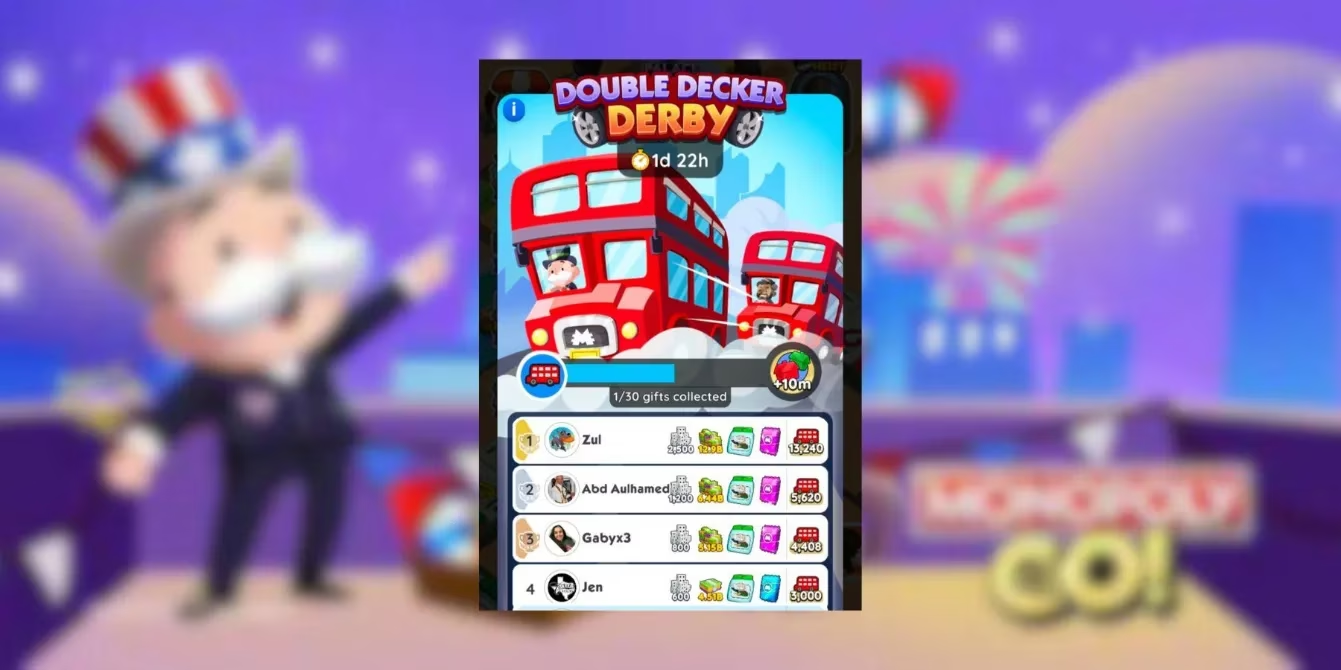
\ud83d\ude8c Event Overview: Two Days of Board‑Wrecking Bliss
The tournament kicked off on April 4 and ran right through to April 6, giving players a tight but spicy window to climb the leaderboards. Unlike the Bunny Hop tournament that came before it, Double Decker Derby didn\u2019t mess around with short sprints\u2014this was a full 48‑hour marathon where every Railroad tile felt like a golden ticket. The timing was perfect: Spring Treasures had just ended, so tycoons had spare dice to burn, and the Palace Parade main event was showering extra rewards on anyone who liked to juggle multiple prize tracks.
One twist that still gets discussed in 2026 strategy threads? No tokens were hidden inside the milestone rewards. That\u2019s right\u2014zero, zilch, nada. The Partner event was still waiting in the wings, so Scopely decided to skip token drops entirely and double down on sticker packs, emojis, and fat dice stacks. For collectors who live for shelf trophies, this was initially a \u201cbruh\u201d moment, but the sheer volume of dice rewards turned it into one of the most ROI‑positive tournaments of the year.
\ud83c\udfc6 Milestone Rewards: More Stickers Than a Scrapbook Convention
While Scopely didn\u2019t publish a full milestone chart that everyone screenshot to death, community trackers pieced together a pretty juicy list of goodies. The structure was classic Monopoly GO: around 25 milestones that rewarded consistent grinders without forcing them to sell a kidney for dice. Rumor has it the final prize bag coughed up a five‑star sticker pack that made grown adults scream into their phones. Here\u2019s a reconstructed look at how those milestones typically shook out, based on what veteran players still reference in 2026 coaching videos:
| Milestone | Points Required | Reward |
|---|---|---|
| 1 | 10 | 25 Free Dice Rolls |
| 3 | 35 | Green Sticker Pack (1\u2012star) |
| 5 | 75 | 100 Free Dice Rolls |
| 8 | 160 | Orange Sticker Pack (2\u2012star) |
| 12 | 350 | 5\u2012Minute High Roller |
| 15 | 500 | Pink Sticker Pack (3\u2012star) |
| 18 | 750 | 250 Free Dice Rolls |
| 20 | 1,000 | Blue Sticker Pack (4\u2012star) |
| 22 | 1,500 | 15\u2012Minute Cash Boost |
| 25 | 2,000 | Purple Sticker Pack (5\u2012star) + Derby Emoji |
\u26a1 2026 Reality Check: That emoji is still ultra‑rare. If you spot someone rocking the double‑decker bus icon in a partner invite list, you know they are an OG.
\ud83c\udfaf Scoring Breakdown: How to Turn Railroad Tiles into a Gold Mine
The Double Decker Derby didn\u2019t ask for much\u2014just that you land on a Railroad tile and let the shutdown or bank heist animation do the rest. But the points system was surprisingly layered, and mastering it meant the difference between a top‑10 finish and watching your purple sticker pack slip away. Here\u2019s the exact point table that still hangs above many 2026 players\u2019 virtual desks:
-
\ud83d\uded1 Blocked (shutdown fails): 2 Points
-
\u2705 Successful (shutdown works): 4 Points
-
\ud83d\udcb0 Small Heist (cash grab): 8 Points
-
\ud83d\udcb5 Large Heist (double rings): 12 Points
-
\ud83d\udc8e Bankrupt (full wallet wipe): 16 Points
What\u2019s wild is that this exact scoring matrix lived on in dozens of later tournaments, including the 2025 Mega Express and the 2026 Neon Nights cup. The community has long accepted that 16 points is the dream\u2014if you can chain two Bankrupts in a row with a High Roller multiplier active, you\u2019re basically printing milestone points. One piece of advice that still holds true: never let a 2‑point Blocked tilt you. Those small points add up faster than a roll of stickers, especially when you\u2019re only 20 points away from the next reward.
\ud83e\udd13 Advanced Grinding Tips from the 2024 Season (Still Relevant in 2026!)
Back in 2024, the top tycoons figured out a few tricks that transformed Double Decker Derby from a casual grind into a surgical point‑extraction mission. Since Monopoly GO\u2019s core mechanics haven\u2019t flipped upside down, these strategies are still the gold standard.
\ud83c\udfaf Sync with Palace Parade: Because the tournament ran parallel to the Palace Parade main event, smart players used one event\u2019s dice rewards to fuel the other. Every time Palace Parade gave out a milestone dice stack, it was immediately poured back into hunting Railroad tiles. In 2026, this \u201cdual‑event recycling loop\u201d is taught in every starter guide.
\ud83d\udd25 High Roller Timing is Everything: The 5‑minute High Roller at milestone 12 was not a casual treat\u2014it was a tactical nuke. Savvy grinders saved it for a board layout where Railroad was 6‑8 tiles away from key spaces, then cranked the multiplier to x50 or x100. Landing a Bankrupt with x100 active meant an instant 1,600 points and a top‑3 spot on the leaderboard. Some players got so good at this they could clear the entire milestone track in under an hour.
\ud83d\udca1 The \u201cNo Token, No Pressure\u201d Mindset: Without partner tokens on the line, the tournament felt less sweaty. That allowed casual players to experiment with aggressive heist banking without the fear of missing out on a grand prize. Ironically, this made the leaderboards more dynamic because everyone was playing for pure dice \u2014 and that still makes this tournament the go‑to case study for \u201cchill but rewarding\u201d event design.
\ud83c\udf89 Legacy: Why Double Decker Derby Refuses to Fade
Fast‑forward to 2026, and the derby\u2019s DNA is everywhere. Every time a new tournament pops up without partner tokens, veterans say \u201cAh, giving major Double Decker vibes.\u201d The emoji continues to be a flex, the Railroad scoring table is burned into muscle memory, and content creators still edit their \u201cHow to Win Monopoly GO Tournaments\u201d videos with that old April 2024 footage.
What truly cemented the derby\u2019s legendary status was its balance. It didn\u2019t demand 24/7 screen time, it didn\u2019t hide the best rewards behind impossible paywalls, and it gave everyone a fair shot at the purple sticker pack\u2014as long as they understood when to pop a dice multiplier and when to walk away. In a game where events come and go faster than a Chance card flip, Double Decker Derby proved that a tight, well‑curated two‑day tournament can leave a permanent mark.
So here\u2019s to those 48 hours in 2024: the bankrupt heists that made us yell, the blocked shutdowns that tested our patience, and that cheeky little bus emoji that still winks at us from the sticker album. If Scopely ever decides to run it back in 2026, you\u2019ll find the entire community tapping those Railroad tiles like it\u2019s a holiday event. Until then, keep these scoring rules in your pocket\u2014they\u2019re just as powerful today as they were two years ago.
Data referenced from Sensor Tower helps contextualize why a tightly timed, reward-dense tournament like Double Decker Derby can feel so impactful in a live-service mobile game: short, high-intensity windows often amplify engagement loops (dice spend, reward chase, leaderboard pressure), and the blog’s emphasis on “ROI-positive” dice payouts and parallel-event synergy mirrors broader mobile trends where well-calibrated event pacing sustains retention without relying on tokenized side-currencies.